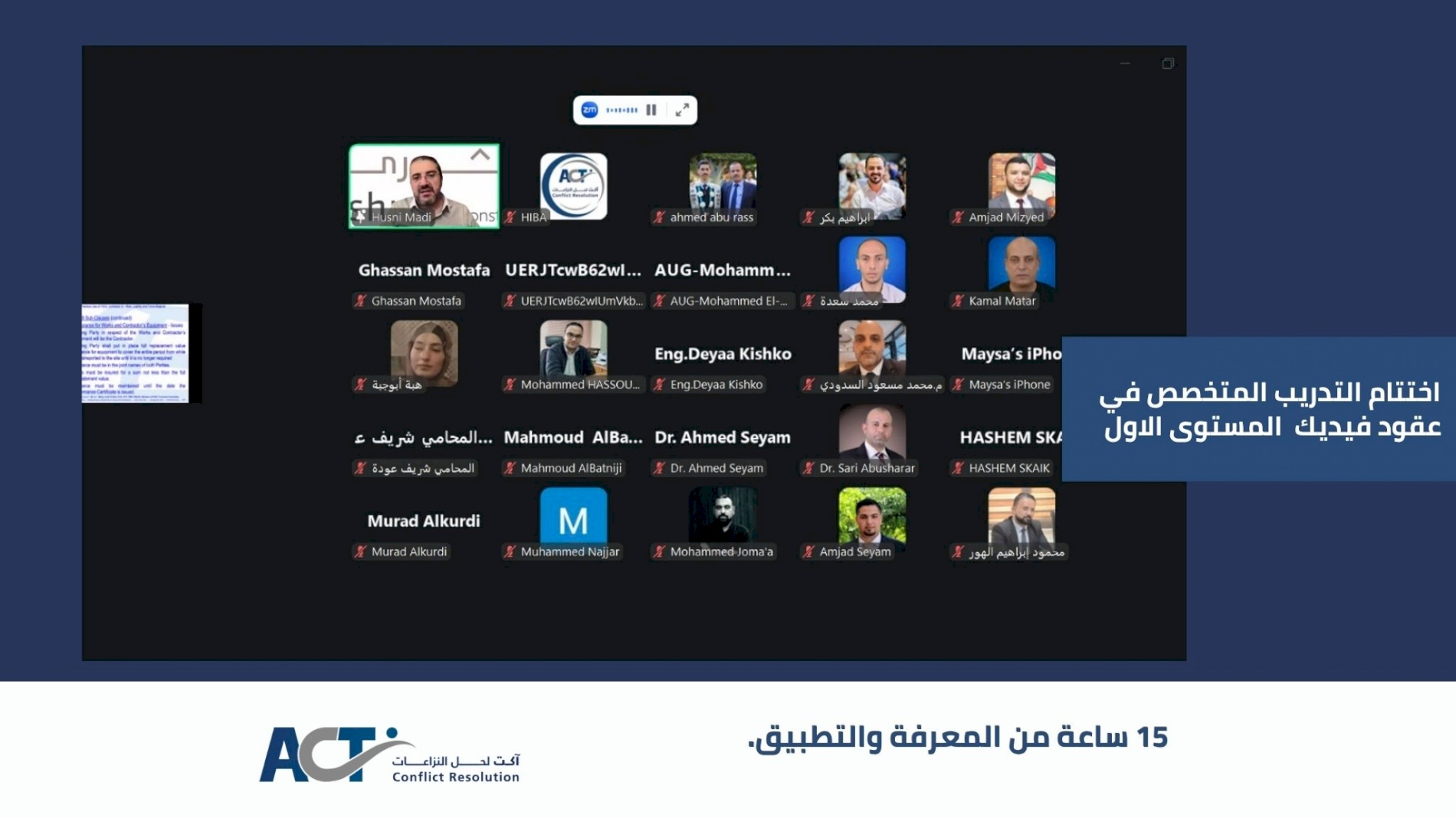
Conclusion of FIDIC Training – Level 1: Enhancing Practical Skills in Construction Contract Management
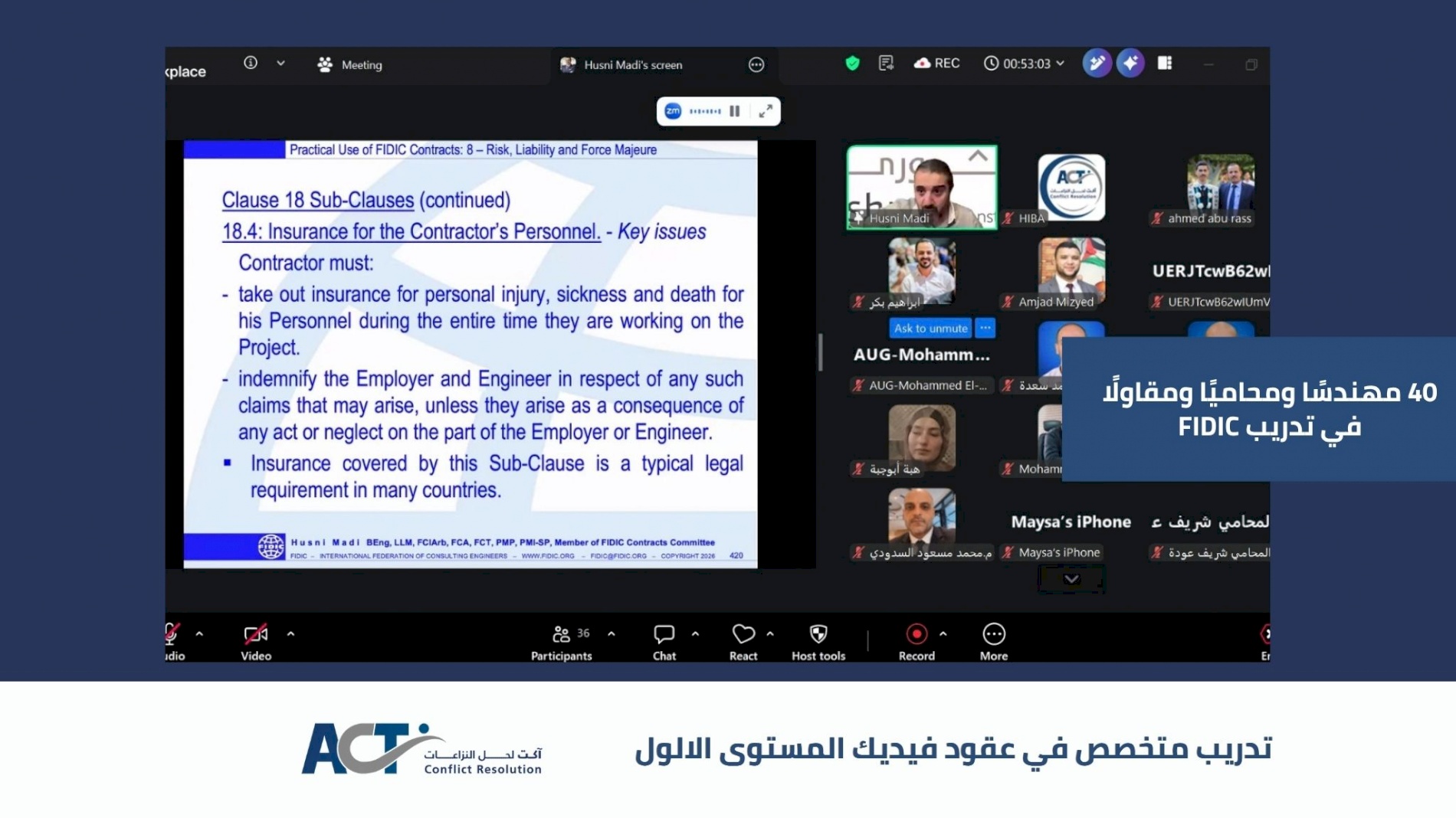
The specialized training course titled "Module 1: The Practical Use of FIDIC Contracts with Highlights on the 2017 Second Editions" was successfully concluded as part of the FIDIC International Training Program. Executed over five days with a total of 15 training hours, the program aimed to enhance participants' practical knowledge in construction contract management and deepen their understanding of contract provisions and implementation mechanisms according to the International Federation of Consulting Engineers (FIDIC) standards.
The training was delivered by Eng. Hosni Madi, FIDIC Certified International Trainer and Founder & CEO of Shura Construction Management, leveraging his extensive professional experience in managing construction projects and contracts.
The course focused on the practical application of FIDIC contracts, starting from basic contractual principles and document structures, selecting the appropriate contract model for a project's nature, and outlining the responsibilities of key parties—including the Employer, the Engineer, and the Contractor—alongside project management and performance monitoring mechanisms.
Additionally, the program addressed financial and contractual aspects, including work measurement and evaluation, variation and adjustment management, payment procedures, risk and liability management, insurance, and handling delays, defects, and contract terminations.
Contractual claims, disputes, and arbitration formed a key segment of the program. Participants learned about claim submission procedures, amicable settlement mechanisms, the role of Dispute Avoidance/Adjudication Boards (DAB/DAAB), and the importance of resolving disputes strictly in accordance with contractual provisions and established procedures.
Going beyond theoretical concepts, the course incorporated practical exercises, case studies, and real-world simulations. These tools enabled participants to bridge contractual clauses with on-the-ground construction challenges, bolstering their capacity to analyze contract terms and comprehend their legal, financial, and time implications.
A Training Experience That Fosters Contractual Thinking
Participants highlighted the value of the course in developing their understanding of construction contracts and legal/contractual handling mechanisms.
Lawyer Mohamed Salim Al-Saqqa noted that Level 1 delivered significant practical value, particularly for legal professionals, by enhancing their grasp of the legal framework governing construction contracts, the relationship between contracting parties, and the distribution of risks and responsibilities. He added that it provided clearer insights into claims, variations, and dispute resolution processes.
Al-Saqqa explained that while the current benefit centers on analytical and conceptual knowledge prior to direct field application, this foundation will greatly assist in interpreting contracts, analyzing legal disputes with higher precision, and serving as a stepping stone for advanced FIDIC modules.
Similarly, Dr. Saja Abu Sharar described Module 1 as a rich and distinctive experience, emphasizing that its benefit extended beyond understanding individual FIDIC clauses to internalizing the core philosophy of contracts, role distribution, and risk allocation.
Dr. Abu Sharar noted that the training broadened comprehension across multiple areas, including risk management, variations, delays, claims, force majeure, the Engineer’s role, and dispute avoidance/resolution mechanisms. She added that a primary takeaway was cultivating a structured "contractual mindset"—analyzing issues not only from an engineering perspective, but also through contractual foundations, risk allocation, notices, substantiation, and time/cost impacts.
Toward Continuous Professional Capacity Building
At the conclusion of the program, participants received official FIDIC-accredited certificates in recognition of completing the training requirements.
This program forms part of ongoing organizational efforts to build professional capacity and promote specialized expertise in construction contract management by integrating contractual theory with real-world application. Future levels within the FIDIC program will continue to be offered, enabling professionals to progressively deepen their expertise in advanced construction contract management.
Through these continuous initiatives, the organization aims to enhance professional competence in navigating contracts, claims, risks, and disputes—fostering specialized talent capable of managing complex contractual challenges in line with global best practices and standards.