The Tawafoq Initiative: Capacity Building for Gaza Engineers Toward Consensus-Based Solutions for Professional and Technical Disputes
Deir al-Balah – Gaza Strip
In a professional environment where contracts, specifications, costs, timelines, and liabilities constantly intersect, engineering disagreements can rapidly escalate from professional differences into complex disputes. Consequently, an urgent need has emerged to enhance the capacity of engineering sector professionals to understand and manage disputes in their early stages using dialogue, negotiation, mediation, and consensus-based tools.
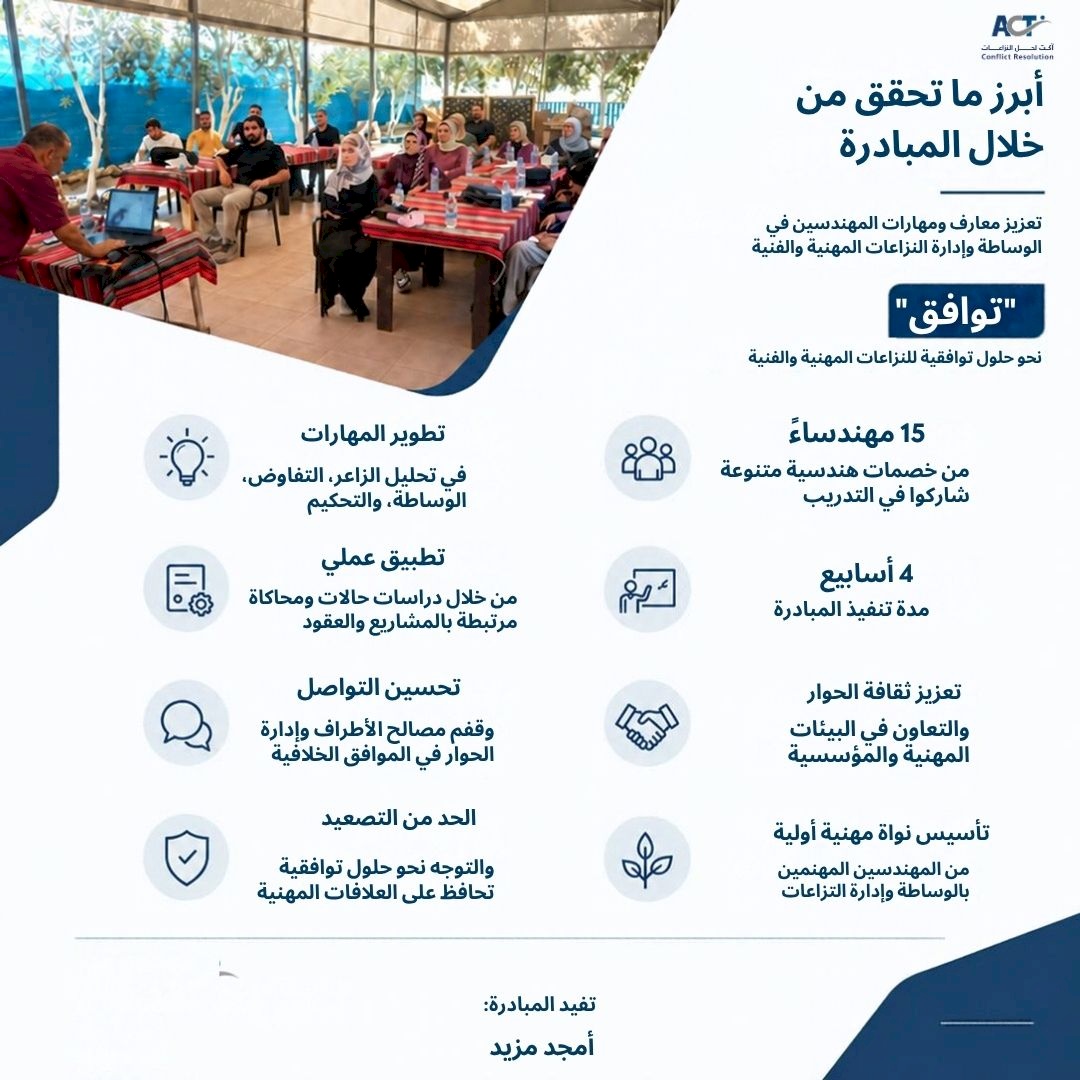
In response to this need, the "Tawafoq" Initiative Toward Consensus-Based Solutions for Professional and Technical Disputes was implemented. The initiative aims to enhance the knowledge and skills of female and male engineers in conflict analysis, communication, negotiation, and mediation—empowering them to manage technical and professional disputes systematically, minimize escalation, and preserve professional relationships.
The initiative was executed in Deir al-Balah during July and August 2026 as part of an applied training program targeting male and female engineers with relevant experience and interest in projects, contracts, and dispute management.
18 Participants | 120% Target Achievement
The initiative achieved results exceeding its initial baseline target. Instead of reaching 15 participants, the program successfully engaged 18 male and female engineers, representing a 120% achievement rate against the planned indicator.
Women represented a remarkable proportion of the cohort, with female engineers accounting for 12 out of the 18 participants (66.1%), significantly surpassing the targeted gender inclusion indicator. Furthermore, 100% of participants belonged to the youth demographic (aged 18–35), while 14 participants were direct beneficiaries from internally displaced populations (IDPs).
Beyond numerical participation, these indicators demonstrate the initiative’s reach into a young, diverse professional demographic and reflect a high level of demand for developing non-traditional dispute resolution mechanisms within the engineering sector.
18 Training Hours: From Concept to Practice
The initiative was designed to go beyond theoretical knowledge transfer by integrating learning with practical execution. Across 4 training days, 4 core activities were carried out—structured into 8 theoretical and practical application sessions—while maintaining the full approved hourly volume and core curriculum.
The program commenced with foundational modules on understanding conflict dynamics and the engineer's role. It then progressed to advanced communication skills, active listening, interest-based negotiation, and mediation principles—culminating in practical case labs, simulation exercises, and a final evaluation session focused on lessons learned and future action planning.
On the practical front, 3 real-world case studies and simulation exercises were conducted, addressing disputes tailored to the engineering work environment, including project delays, cost overruns, material specifications, allocation of liability, and contractual relationships. This applied methodology enabled participants to test learning tools in practice and analyze disputes through a practical problem-solving lens rather than merely reviewing theoretical concepts.
From "Who is at Fault?" to "How Do We Reach a Solution?"
One of the most notable outcomes of the initiative emerged during a simulation session that tackled a professional dispute involving project delivery delays and conflicting liabilities among contracting parties.