Building Local Capacity for Conflict Resolution Within Shelter Camps in Gaza
In an environment marked by escalating daily friction and severely restricted access to traditional justice mechanisms, the ability to manage disputes within local communities is more than just a skill—it is a critical necessity for maintaining social cohesion and safeguarding the rights of the most vulnerable groups.
Driven by this necessity, the initiative "Building Awareness Cells in Shelter Camps in Gaza City: Qualifying Camp Administrations and Human Rights Activists on Mediation and Peaceful Resolution" was launched. Supported by ACT Conflict Resolution and led by Mohammad Omar Shehab under the umbrella of the Palestinian Center for Democracy and Conflict Resolution (PCDCR).
The initiative did not merely aim to deliver temporary awareness sessions; its core premise was centered on establishing sustainable local capacity that remains within the shelter camps long after project funding ends. Therefore, it targeted two groups with a direct presence in daily camp life: Camp Administrations, leveraging their community reach and influence, and Human Rights Activists, utilizing their expertise in monitoring and documenting rights issues.
From Training to Building Awareness Cells
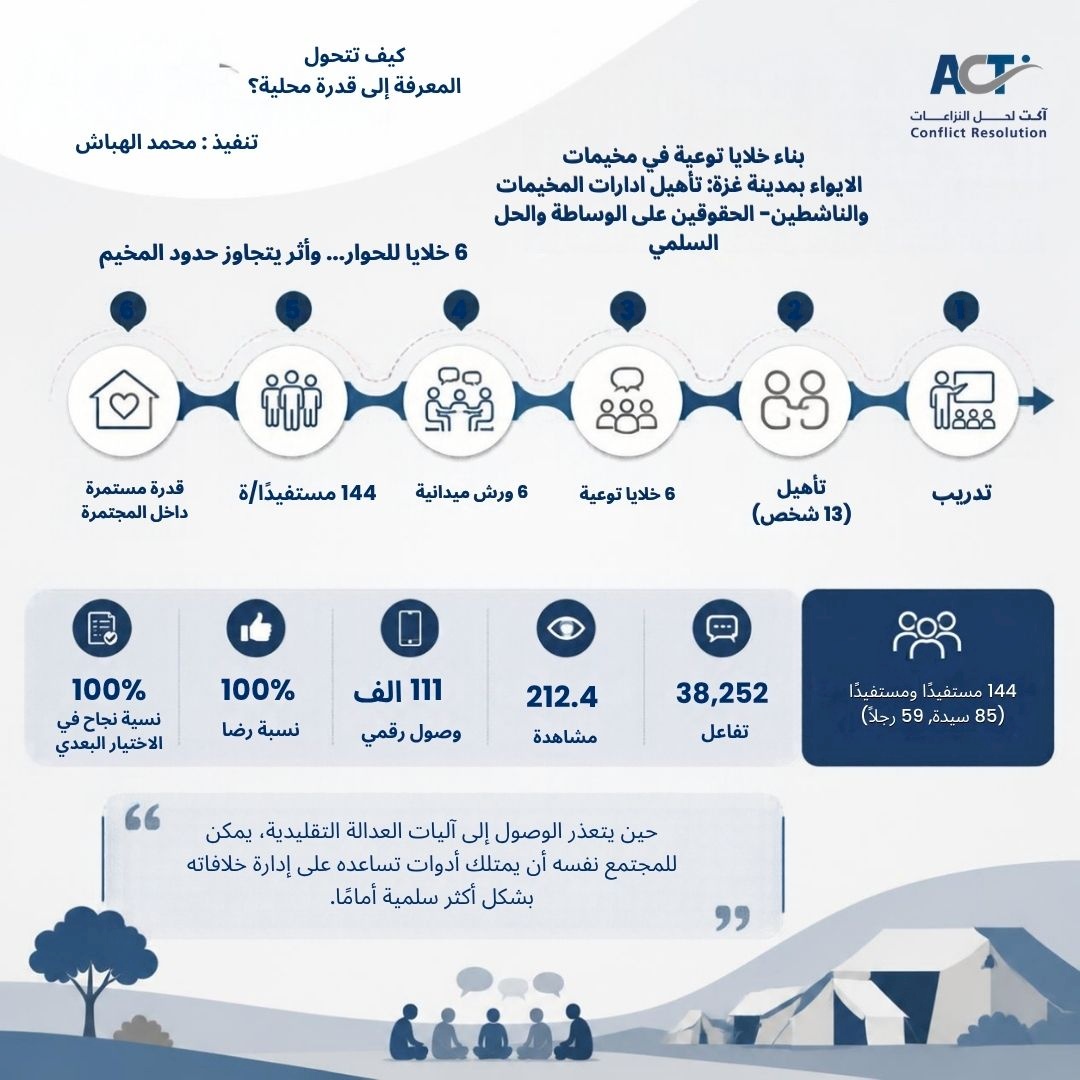
The initiative began by qualifying 13 participants from camp administrations and human rights activists through a specialized 15-hour training program.
The curriculum covered conflict concepts and dynamics, Alternative Dispute Resolution (ADR) mechanisms—including negotiation, mediation, conciliation, and arbitration—alongside core mediation skills, "Do No Harm" principles, scope of intervention limits, and practical applications.
The training extended beyond theory to include two realistic simulations derived from the living conditions in displacement camps:
A full mediation session addressing a dispute between two families over shared space utilization.
An arbitration simulation resolving a conflict regarding ownership of shared facilities.
Pre- and post-test results demonstrated a significant gain in knowledge:
Average participant scores rose from 8.38 to 9.54 out of 10.
Success rate (participants meeting the passing criteria) increased from 92% to 100%.
Specialized concepts saw notable growth: Understanding the appropriate context for arbitration surged from 46% to 85%, while comprehension of intervention boundaries—specifically refraining from mediating inheritance and custody cases—rose from 69% to 100%.
Six Cells Transferring Knowledge to the Camps
Following the training, participants transitioned from knowledge recipients to facilitators. 12 graduates paired up to form six awareness cells, which took charge of conducting field workshops within their local communities.
These cells facilitated 6 awareness workshops reaching 144 participants (85 women and 59 men). Notably, 4 out of the 6 workshops were exclusively dedicated to women, reflecting the initiative’s responsiveness to gender-specific needs in displacement contexts and its commitment to creating safe, private spaces for participation.
Workshops covered mediation, arbitration, dialogue, active listening, and ADR mechanisms using real-life camp examples and active role-plays rather than static lectures:
In one workshop, facilitators presented a simplified model of a dispute between two families over water collection queues, which was successfully resolved through mediation steps.
In another, small groups applied structured mediation and arbitration steps to actual case scenarios.
The workshop at Halawa Camp provided an essential bridge to existing community structures, engaging 29 men—including notables, traditional reconcilers (Wajahas), camp administration representatives, and the director of the Halawa Camps Compound (which encompasses 12 camps).
Protecting the Most Vulnerable
From its inception, the initiative linked knowledge dissemination with a broader mandate: reinforcing protection and preserving dignity for the most vulnerable populations, particularly widows, orphans, displaced persons, and persons with disabilities.
Accordingly, the training emphasized strict limits on mediator intervention, highlighting when to step back or refer sensitive cases—especially regarding inheritance and child custody—to specialized authorities. Participant awareness of these referral boundaries reached 100% (up from 69%).
The accompanying digital campaign reinforced these principles by broadcasting messages on safeguarding the vulnerable, confidentiality, and safe referrals, reinforcing a "Do No Harm" approach to community dispute resolution.
Complete Satisfaction and Field Impact
Measuring initiative success went beyond tracking activity counts and beneficiary numbers. A satisfaction survey conducted with a representative sample of 32 respondents showed a 100% satisfaction rate, averaging 4.74 out of 5.
The highest rated indicator (4.91 out of 5) pertained to the facilitators' clarity and the relevance of their examples to daily camp life. Additionally, 10 qualitative feedback interviews were conducted with a diverse participant sample (50% women).
These results confirm that knowledge moved effectively from the classroom to the field, as the performance of the local graduates themselves in facilitating discussions was among the highest-rated aspects by attendees.
Expanding Reach Through Digital Platforms
To extend messaging beyond direct participants, an integrated digital campaign ran alongside field activities. It featured an animated motion-graphics video and 5 awareness posters, backed by a targeted paid campaign across PCDCR’s official Facebook and Instagram pages.
During the execution month, the digital campaign achieved:
111,000 Reach
212,400+ Total Views
38,252 Engagements
13,833 Full Video Views
This dual-track approach successfully combined deep capacity building inside the camps with broad messaging across digital platforms.
From a Temporary Initiative to a Scalable Model
The true value of the "Building Awareness Cells" initiative lies in treating community awareness not as a one-time activity that expires with funding, but as a sustainable model anchored by qualified local actors who continue to pass on knowledge.
The six cells are now embedded within their communities as active resources. Furthermore, project impact extended beyond the initial target sites—demonstrated when the director of the Halawa Camps Compound reached out to collaborate, and a representative from a Khan Younis camp contacted PCDCR after following the digital campaign.
High workshop attendance and strong digital engagement revealed that community demand for dispute resolution knowledge exceeded initial capacity. This challenge highlights a compelling opportunity to scale this framework in future phases.
Supported by ACT Conflict Resolution and executed by Mohammad Omar Shehab under PCDCR, this project demonstrates how mediation and ADR can shift from theoretical legal concepts into accessible tools owned and utilized by community members.
In the context of shelter camps—where resource scarcity intersects with daily friction and an urgent need for peaceful resolutions—investing in community members who can listen, facilitate dialogue, respect intervention limits, and safely refer complex cases is more than an awareness activity: it is a foundational step toward building resilient local capacity that endures and expands over time.
The ultimate objective was not merely to teach people what mediation is, but to ensure that within every community, someone knows how to open a space for dialogue the moment a conflict begins.