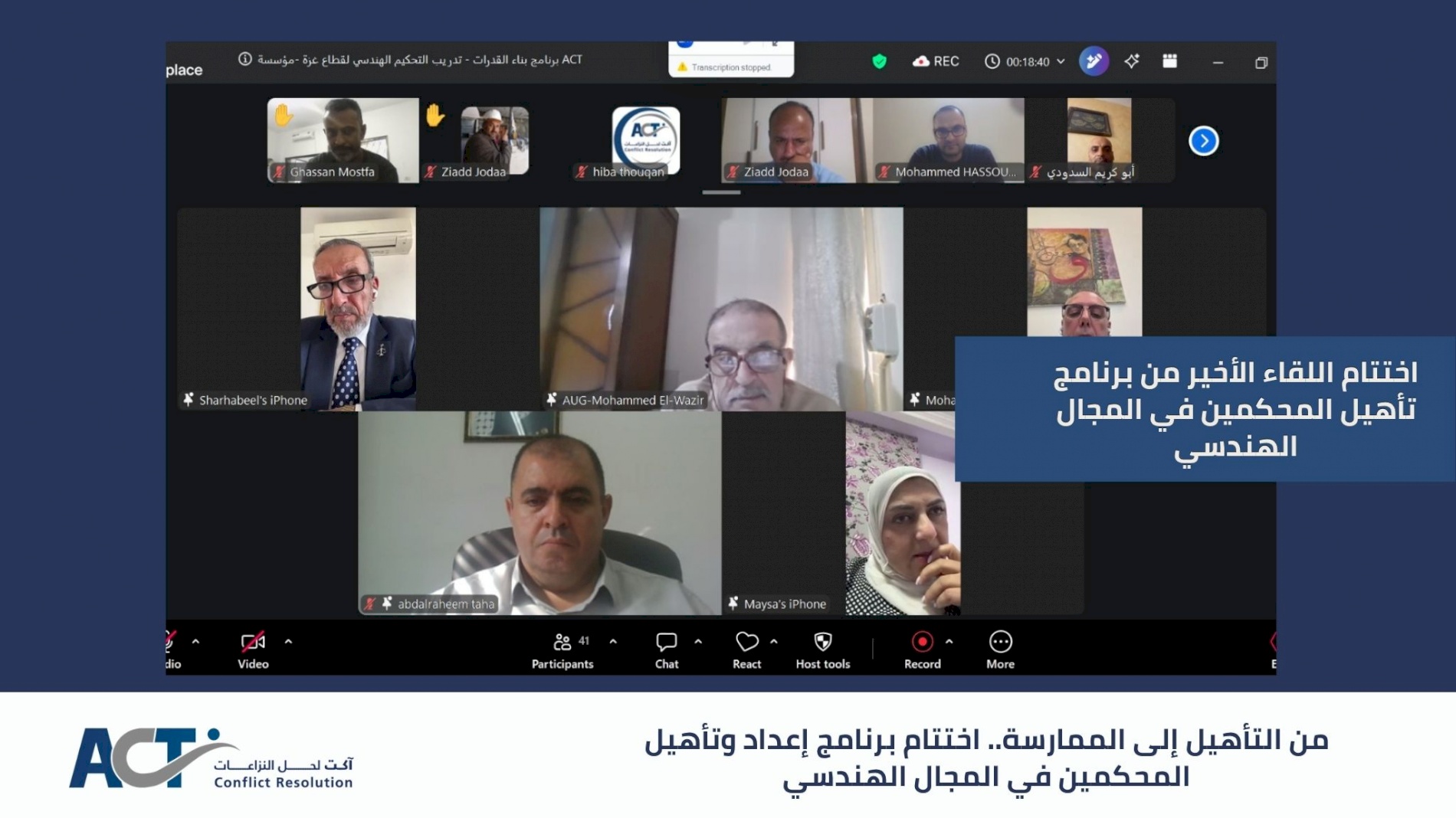
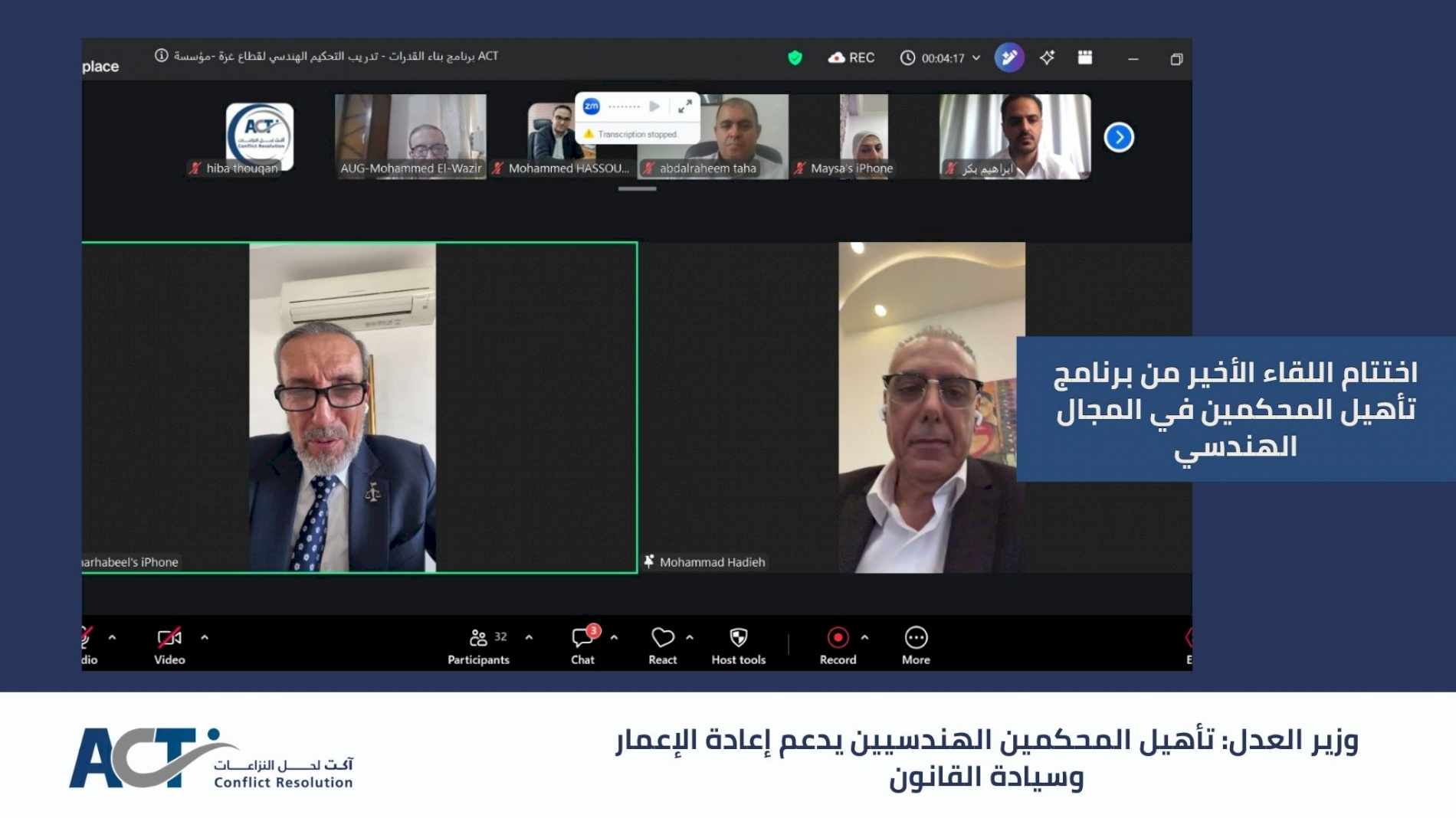
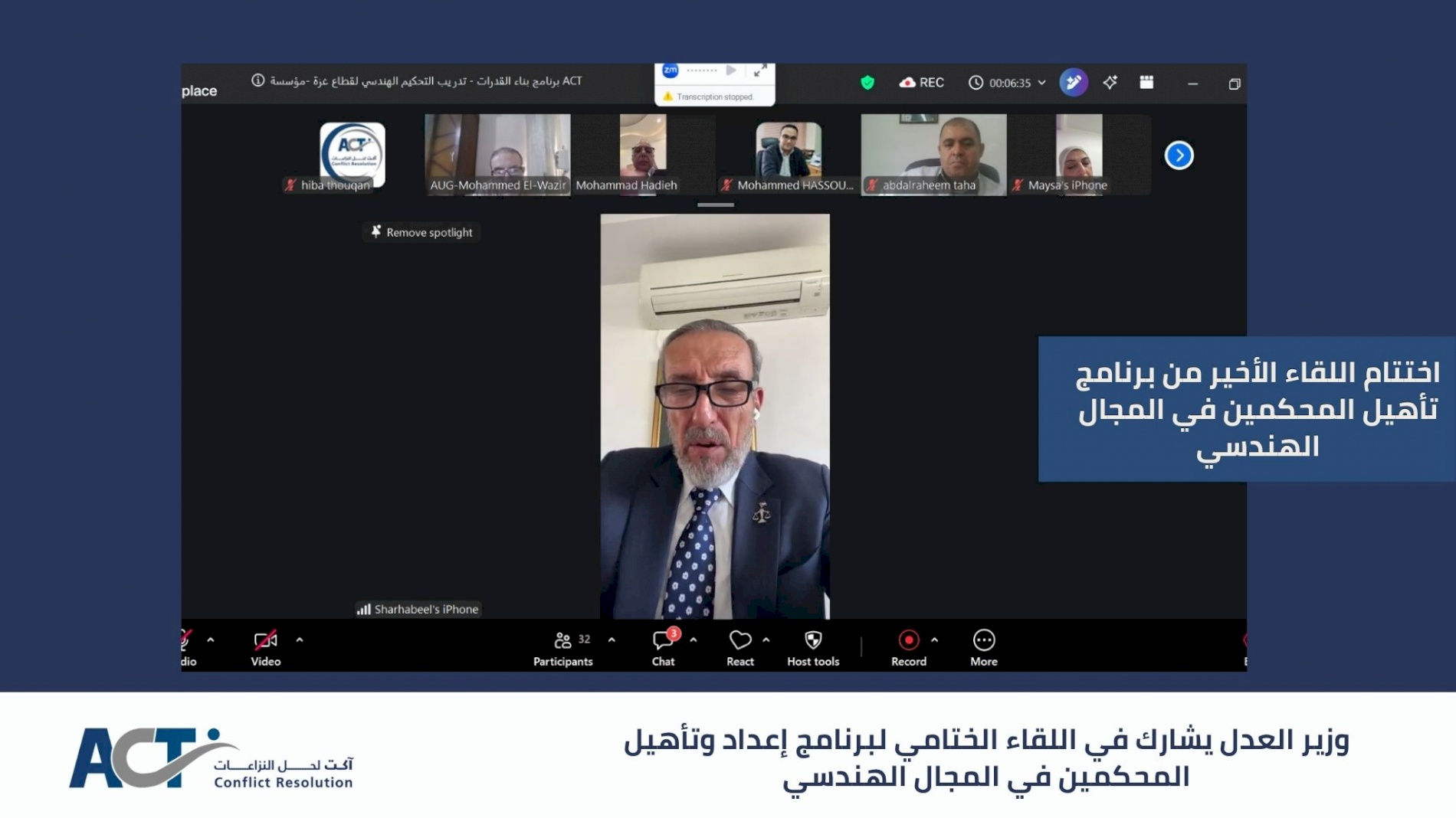
Conclusion of the Program for Preparing and Qualifying Arbitrators in the Engineering Arbitration Program with the participation of His Excellency the Minister of Justice
The program for preparing and qualifying arbitrators in the engineering field concluded with the tenth and final session of the first phase of the Engineering Arbitration Program in Gaza, attended by His Excellency the Minister of Justice, Counselor Sharhabeel Al-Za’eem, and Mr. Mohamed Hadiya, Chairman of the Board of ACT for Conflict Resolution, along with a distinguished group of engineers, lawyers, and contractors — totaling 40 participants in the training program.
In his speech, His Excellency the Minister of Justice, Counselor Sharhabeel Al-Za’eem, emphasized the importance of developing the arbitration system in Palestine, particularly in the engineering sector, as an effective tool to accelerate dispute resolution and strengthen confidence in alternative dispute resolution mechanisms. He noted that qualifying specialized arbitrators in this field would contribute to supporting reconstruction efforts and reinforcing the rule of law.
The Minister addressed several professional aspects related to the arbitrator’s role, stressing that an arbitrator’s integrity begins with their personal conduct before the disputing parties, even prior to accepting the arbitration agreement. He highlighted the necessity for arbitrators to carefully study the arbitration agreement, procedures, and methods, while maintaining neutrality, independence, and professional responsibility.
During nearly an hour of interventions and discussions with engineers and lawyers, a series of questions and inquiries were raised regarding arbitration practice and professional qualification requirements. His Excellency engaged with participants’ contributions and responded to their questions, in a dialogue that explored various issues and challenges associated with the arbitration profession.
In the course of the discussion, His Excellency announced that all registered participants in the program would, upon completing the course requirements, receive a joint training certificate issued by the Ministry of Justice and ACT for Conflict Resolution, signed by both the Minister of Justice and the Chairman of ACT, in recognition of their participation and completion of the training program.
He also discussed with participants the possibility of continuing the professional pathway toward obtaining an arbitrator’s certification, affirming the Ministry of Justice’s commitment to facilitating this process for qualified professionals, particularly in Gaza. He stated: "Today, our mission is to make it easier for our people in Gaza by all standards and measures, so that we reach the stage where a person is truly capable of being an arbitrator and bearing the responsibility of conducting arbitration."
Following the Minister’s interventions and discussions, the session moved to Dr. Abdel Rahim Taha and Engineer Mohamed Al-Wazir, who presented a series of practical judicial applications. These included the presentation, discussion, and analysis of several judicial rulings on various arbitration-related issues. This segment provided participants with a practical space to understand how the judiciary addresses arbitration matters, linking the theoretical aspects covered in the program with judicial and practical applications.
The conclusion of the program comes within ACT’s efforts to strengthen the specialized arbitration system in Palestine and to build professional capacities in engineering arbitration, thereby contributing to the development of arbitration practices and enhancing the readiness of professionals to handle engineering disputes with competence, professionalism, and responsibility.