From Trainees to Peacebuilders: Youth Turn a Shelter Dispute into an Opportunity for Dialogue
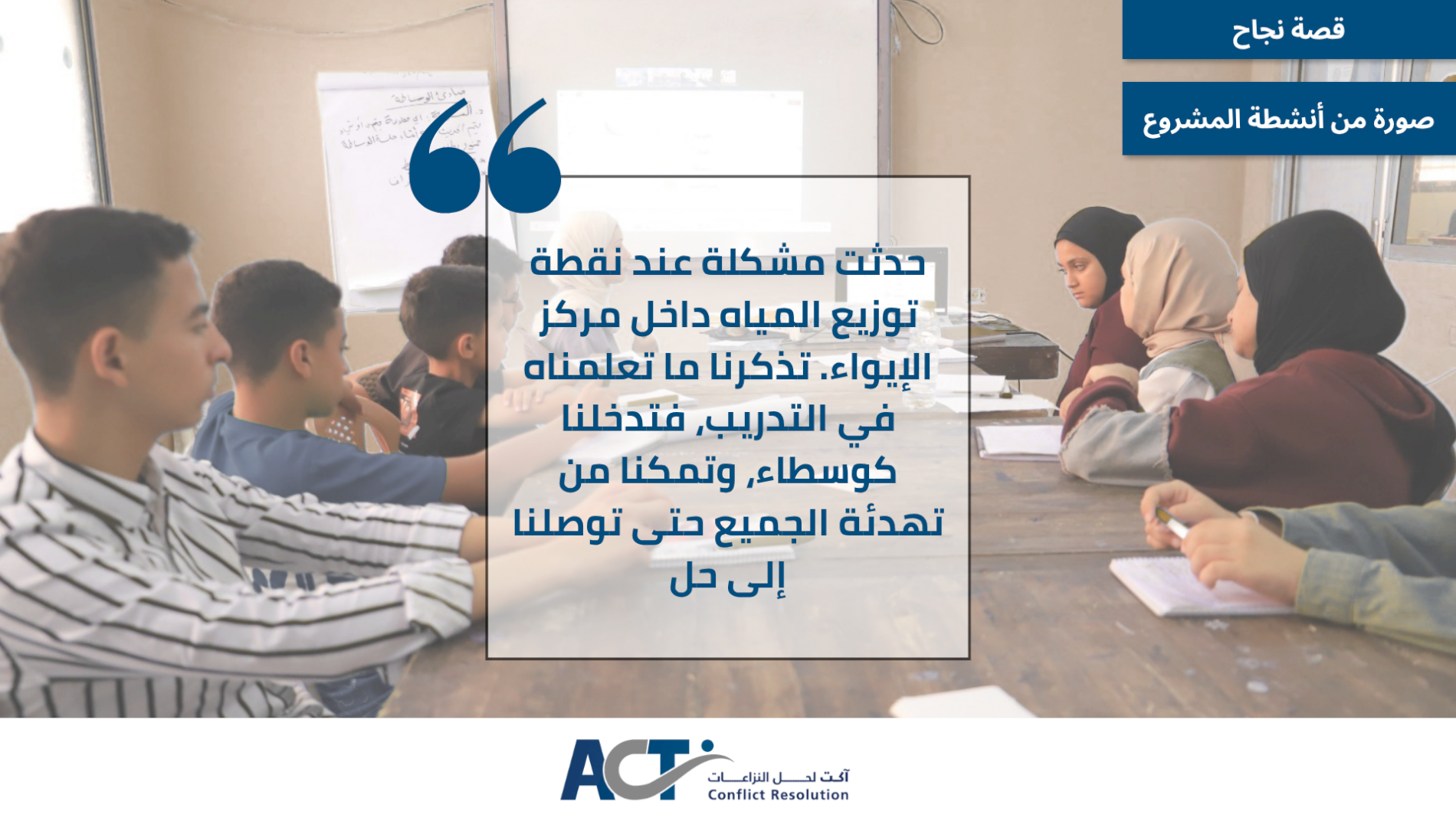
Participants in the peer mediation program during a training session in the Gaza Strip, where they acquired dialogue and mediation skills that later helped them resolve real conflicts within their communities
Amid the difficult humanitarian conditions in the Gaza Strip, temporary shelters have become spaces where residents face daily challenges, most notably overcrowding, scarcity of basic resources, and ongoing psychological pressures. In such circumstances, even minor disagreements can escalate into conflicts that threaten community cohesion and individual safety.
Recognizing the importance of promoting a culture of dialogue and mediation, ACT Conflict Resolution implemented the Peer Mediation Program in partnership with the Culture and Free Thought Association and the Aisha Association for the Protection of Women and Children. The program aimed to empower youth with skills in mediation, effective communication, and peaceful conflict management, enabling them to become active agents of peace within their communities.
The program’s impact extended beyond the training halls and quickly appeared in real life. In one shelter, a dispute broke out among a group of young people while waiting to collect water due to overcrowding and long delays. As tensions rose and voices grew louder, the situation seemed headed toward confrontation that could affect everyone present.
At that moment, several program participants stepped in to apply the skills they had learned. Acting as neutral mediators, they gave everyone a chance to express their views, encouraged mutual listening, and then guided a calm dialogue that helped the parties agree on an organized mechanism to distribute water fairly. Within a short time, the conflict ended without escalation, and calm was restored.
One participant described the experience: "A problem occurred at the water distribution point inside the shelter. We remembered what we learned in training, intervened as mediators, and managed to calm everyone until we reached a solution."
Another added: "Today I feel confident in my ability to help resolve conflicts between my siblings at home and my classmates. Before the training, I didn’t know there was another way besides arguing."
This story reflects the real impact of the peer mediation program, where training went beyond theoretical knowledge to build practical skills that enabled youth to intervene positively in real situations, contain conflicts before they escalated, and strengthen trust in dialogue as an effective tool for addressing disagreements—even under the most difficult humanitarian conditions.
ACT will continue to follow up with participants and provide practical guidance, reinforcing the application of mediation skills in their communities, encouraging them to share these experiences with peers, and contributing to the entrenchment of a culture of dialogue, understanding, and peaceful conflict resolution. This strengthens community cohesion and gives youth an active role in building peace.