Bridges of Dialogue: When youth transform from receivers of knowledge into makers of dialogue
In communities where sources of conflict are many and the need for safe spaces for dialogue is urgent, sustainable responses lie not only in raising awareness about peace and conflict resolution but in empowering community members with tools and knowledge to manage differences more peacefully and effectively.
From this idea emerged the initiative “Bridges of Dialogue: Empowering Youth in Community Mediation to Resolve Conflicts in Gaza”, offering a practical vision of the role of youth in building a culture of dialogue, based on a clear principle: youth should be part of the solution, not merely recipients of knowledge about it.
Supported by ACT for Conflict Resolution and implemented by Rania Jouda, the initiative focused on promoting mediation, dialogue, and alternative dispute resolution methods, while supporting community-driven efforts that give young people greater space to participate in building peaceful and sustainable solutions.
From Knowledge to Practice
The initiative began with the conviction that learning mediation cannot be confined to a training hall. It combined theoretical knowledge with practical application through specialized training on community mediation, alternative dispute resolution, and dialogue skills.
Training relied on simulations of local conflicts, allowing youth to move from understanding concepts to testing them in real-life scenarios. The most significant transformation came after training ended: youth themselves designed activities, distributed roles, and executed awareness sessions, becoming “Ambassadors of Bridges of Dialogue.”
Youth in Action
The initiative gave young people genuine space to design and implement activities, strengthening their sense of ownership. Instead of passively receiving messages about dialogue, they became the ones spreading them. Mediation skills moved from theory to tools actively used in community engagement.
Impact Beyond Numbers
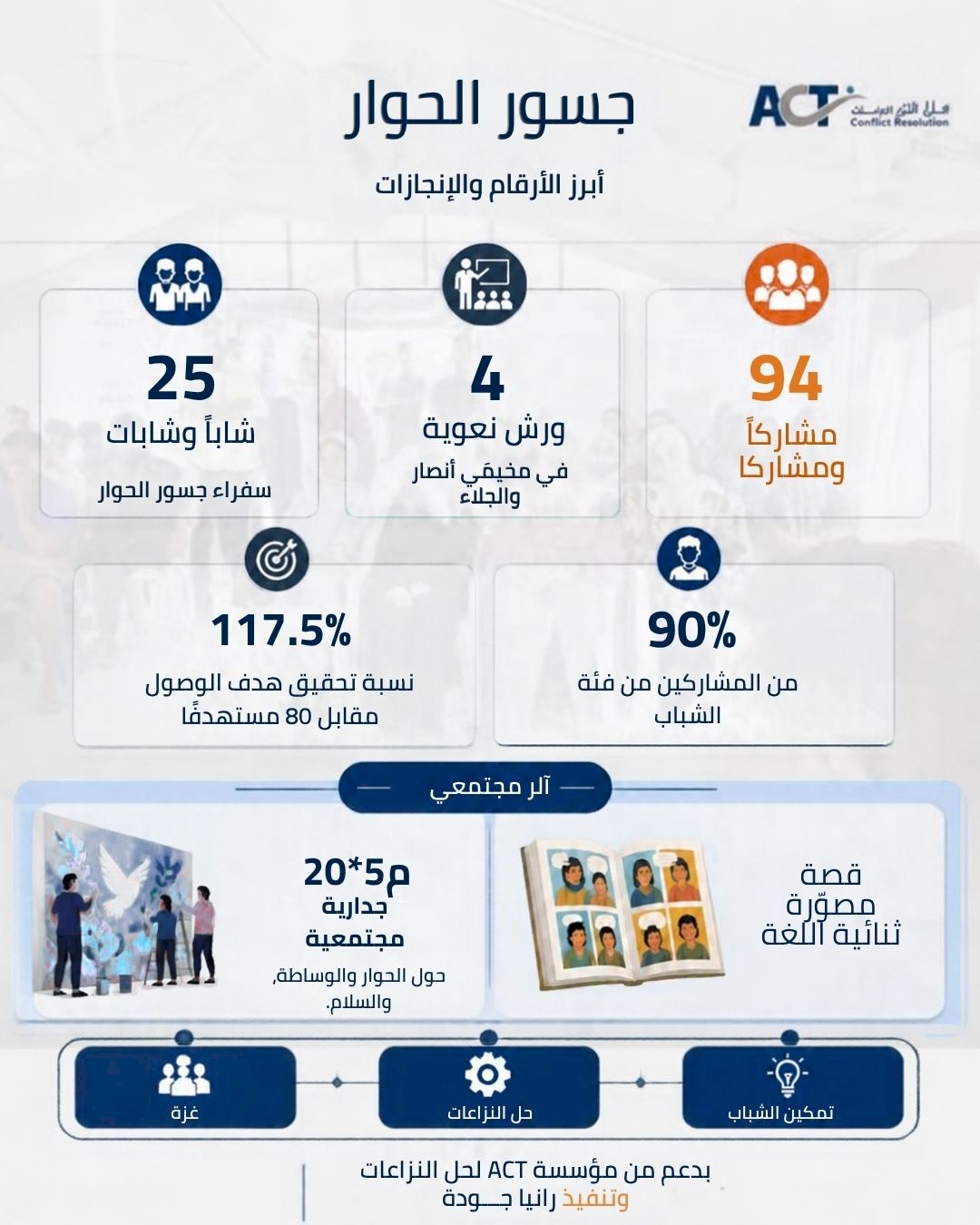
The initiative trained 25 young men and women as ambassadors and held 4 awareness workshops in Ansar and Jalaa camps, reaching 94 participants—117.5% of the target. Importantly, 90% of participants were youth, reflecting strong youth presence and leadership.
Making Mediation Visible
Workshops used interactive methods—role play, theater sketches, and simulations—bringing mediation concepts closer to everyday life. This creative approach made dialogue and mediation more tangible and relatable.
From Training Halls to Public Spaces
The initiative produced lasting tools: a bilingual illustrated storybook on dialogue and mediation, and a large community mural (20m x 5.2m) near universities, carrying messages of peace and dialogue into public space.
Sustainability Begins with the Messengers
The 25 trained youth became a nucleus of ambassadors capable of continuing the mission. Alongside reusable tools—storybooks, training materials, awareness content, and the mural—the initiative ensured its messages could live on in future campaigns.
Lessons Learned
Youth participation in execution strengthens ownership and sustainability.
Learning by practice makes mediation concepts clearer and more impactful than theory alone.
Creativity in outreach—using theater, art, and visual tools—brings dialogue closer to youth.
Flexibility in community work is essential for success in changing environments.