Five Community Initiatives Supported by ACT for Conflict Resolution to Promote the Culture of Mediation, Dialogue, and Peaceful Solutions in the Gaza Strip
Five Community Initiatives Supported by ACT for Conflict Resolution to Promote the Culture of Mediation, Dialogue, and Peaceful Solutions in the Gaza Strip
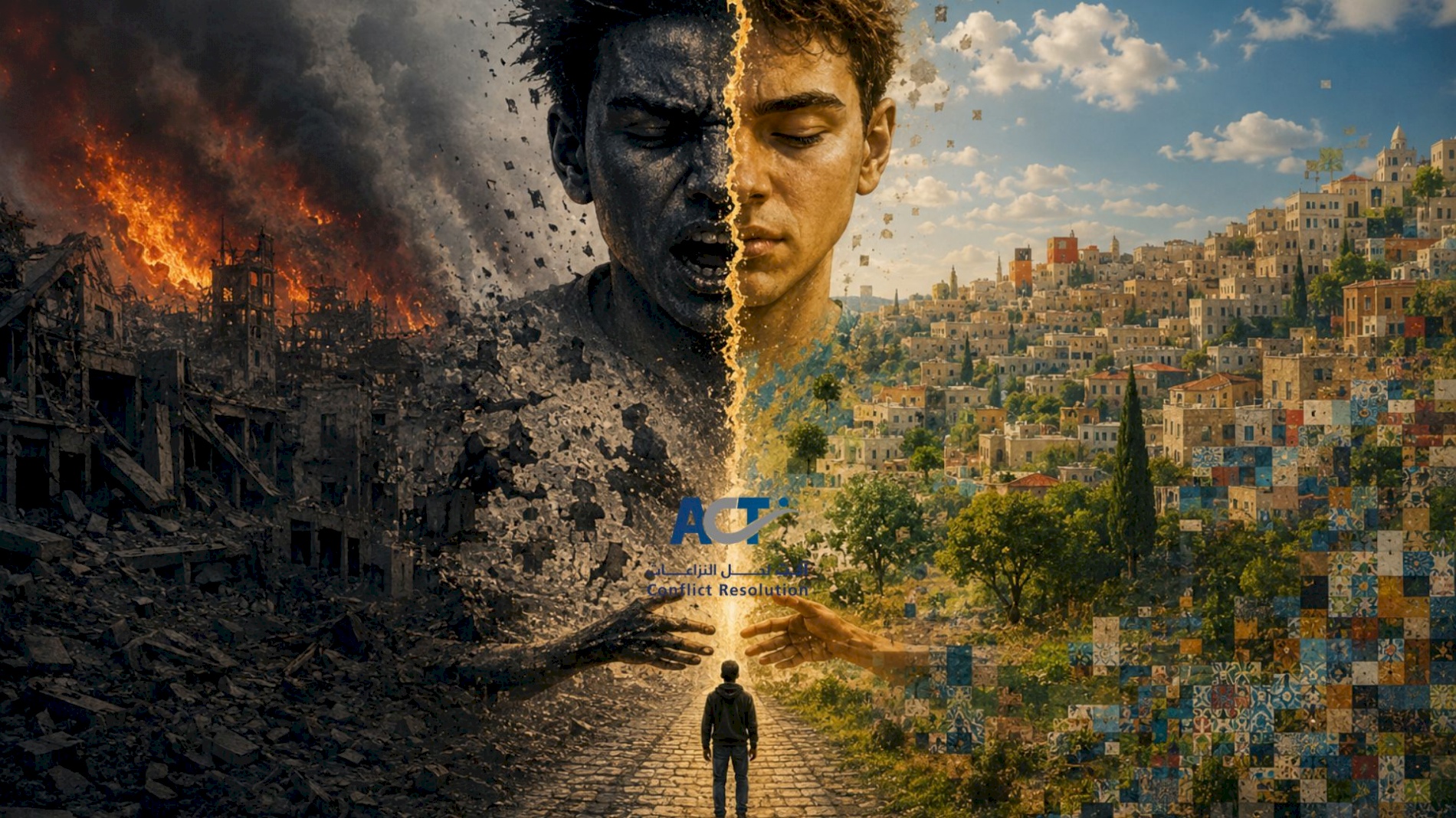
Amid the difficult humanitarian, social, and economic conditions in the Gaza Strip—and the accompanying daily pressures that increase the likelihood of disputes within families, communities, and displacement and shelter camps—ACT for Conflict Resolution is supporting five community initiatives aimed at fostering a culture of dialogue, mediation, and peaceful conflict resolution. These initiatives equip community members with practical tools to address disagreements before they escalate.
These initiatives align with ACT’s commitment to supporting community-led solutions by investing in youth, women, community activists, human rights defenders, and residents of displacement and shelter camps, alongside utilizing digital platforms to reach a broader audience.
The five initiatives carry names reflecting their core objective: "Ambassadors of Peaceful Solutions," "Bridges of Dialogue: Empowering Youth in Community Mediation for Conflict Resolution in the Gaza Strip," and "Promoting Alternative Dispute Resolution (ADR) in Gaza’s Shelter Camps," along with two other community initiatives focused on raising awareness of mediation, dialogue, and alternative dispute resolution methods.
From Training to Community Impact
Under the "Ambassadors of Peaceful Solutions" initiative, 25 young men and women were trained as ambassadors capable of spreading concepts of dialogue, mediation, and peaceful resolution within their communities. The initiative included interactive awareness sessions, the "Solve It Through Dialogue" campaign, and the production of a short documentary film designed to convey peaceful resolution messages to the public through everyday scenarios.
The "Bridges of Dialogue" initiative focused on empowering youth with community mediation tools. It directly trained 20 participants, reaching an indirect audience of at least 80 individuals. The initiative also featured field activities, community awareness sessions, and the creation of a massive mural spanning 20 to 30 meters—serving as a visual space celebrating dialogue and coexistence while reinforcing the initiative's core messages in public space.
In shelter camps, the "Promoting Alternative Dispute Resolution (ADR) in Gaza’s Shelter Camps" initiative adopted a more specialized approach. It trained 12 participants—including camp administrators and human rights activists—in mediation, dialogue, negotiation, conciliation, and arbitration, while emphasizing the principles of neutrality, confidentiality, and protecting vulnerable groups.
Extending beyond training, the initiative established six awareness cells distributed across three camps, conducting six workshops that benefited approximately 120 to 150 camp residents. Furthermore, the initiative produced a 30-second motion graphics awareness video and five digital posts as part of a campaign targeting up to 10,000 individuals across digital platforms.
Why These Initiatives Matter in Gaza
The significance of these initiatives lies in addressing newly emerging forms of conflict in the Gaza Strip—particularly following the war—where conflict has become a element of daily life rather than just a legal or institutional issue. Amid displacement, overcrowding, and severe strain on resources and services, minor disputes over water, aid, shelter, privacy, or family matters can rapidly escalate into larger conflicts.
Accordingly, these ACT-supported initiatives aim to introduce practical tools—such as active listening, dialogue, negotiation, mediation, conciliation, and arbitration—that people can deploy before conflicts escalate, while emphasizing respect for human dignity and the protection of vulnerable populations.
The initiatives rest on the fundamental premise that knowledge should not remain confined to training rooms. Young people, activists, and camp administration members who receive training pass their knowledge on to their families, communities, and surrounding environments, creating a ripple effect that extends far beyond the direct participants.
Investing in People Before Tools
The five initiatives combine training, capacity building, field awareness, community engagement, and digital content creation. They place special emphasis on youth, women, displaced populations, and local community activists.
This approach reflects ACT for Conflict Resolution’s strategy to build community capacity for managing disputes peacefully, rather than merely intervening after conflicts escalate.
In the Gaza Strip, where humanitarian and social crises intersect with daily life, promoting a culture of mediation and dialogue is more than an awareness campaign—it is an investment in social cohesion and in people's ability to preserve relationships and manage differences humanely and peacefully. Through these initiatives, ACT continues working to make mediation, dialogue, and alternative dispute resolution accessible, understandable, and practical within Palestinian society—especially in communities facing the highest levels of pressure and need across the Gaza Strip.