Towards an Actionable Ethical Statement: Session 6 of the Faith Voices 360 Project
Towards an Actionable Ethical Statement: Session 6 of the Faith Voices 360 Project
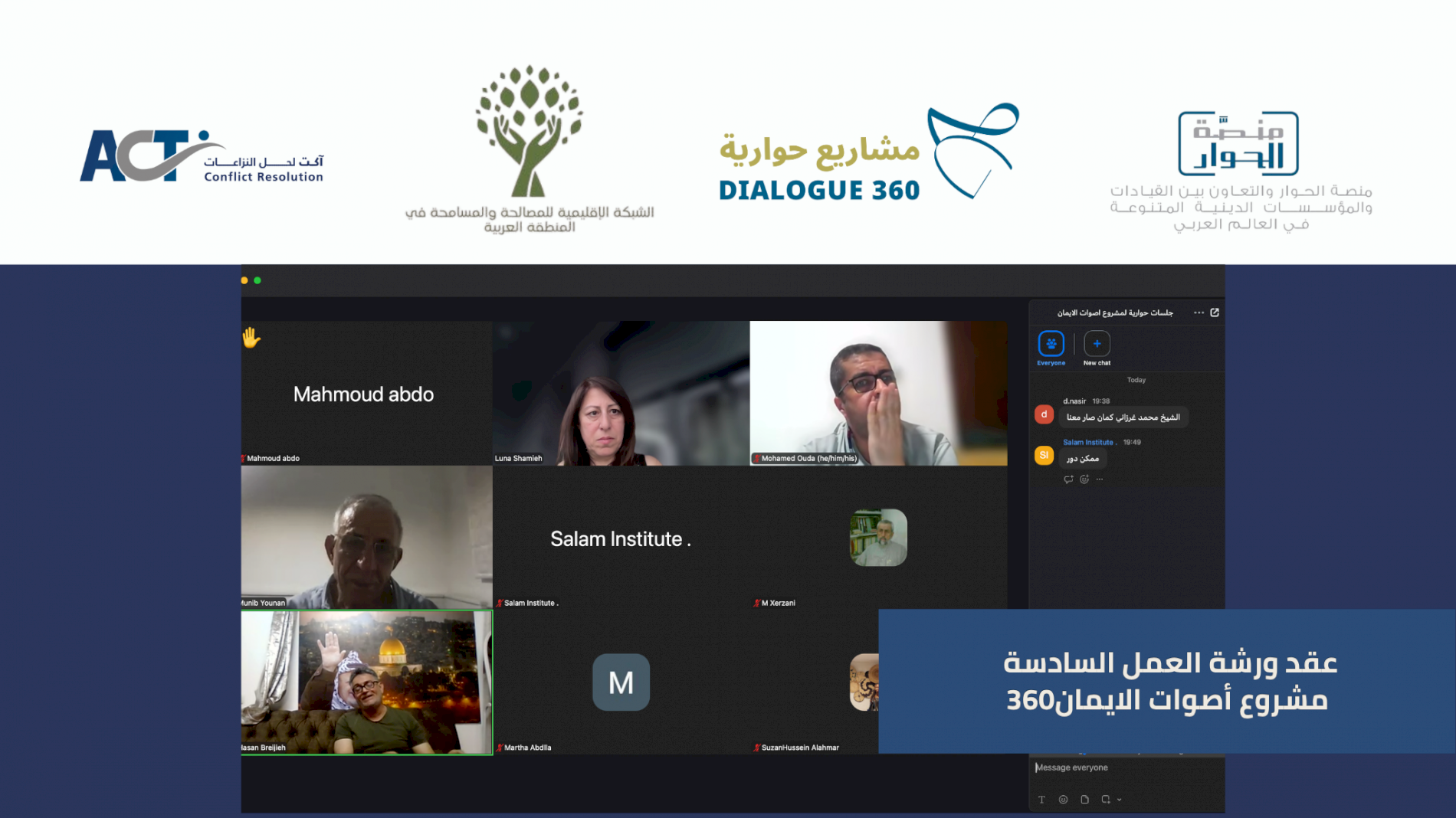
As part of the Faith Voices 360 project, the sixth session was held to discuss the draft ethical statement and its underlying foundational frameworks. This session forms part of a regional dialogue track implemented by ACT for Conflict Resolution, in partnership with the Regional Network for Reconciliation and Forgiveness, and in cooperation with the King Abdullah Bin Abdulaziz International Centre for Interreligious and Intercultural Dialogue (KAICIID).
The session marked a significant milestone in transitioning from conceptualization to validation: Can the statement evolve from a written document into a practical tool? And how can it serve as an ethical benchmark for advocacy, awareness-raising, and engagement with both religious and civic institutions?
Participants examined the key strengths of the draft, particularly its core assertion that the issue lies not in religion itself, but in the misuse of religion—specifically the exploitation of texts, symbols, or religious authority to justify exclusion or hatred. Attendees also stressed the importance of distinguishing between legitimate dissenting discourse and harmful speech, as well as differentiating between sacred text and human interpretation.
Furthermore, discussions highlighted the necessity of broadening the religious and human rights reference points upon which the statement is built. This approach aims to enhance its acceptance across diverse societal components while linking it to existing initiatives and instruments focused on citizenship, human dignity, peaceful coexistence, and the prevention of incitement.
The session concluded that the true strength of the statement lies not merely in its terminology, but in its potential to be translated into an actionable advocacy plan. It stands to serve as a benchmark for developing a code of ethics for religious leaders, as well as an educational framework to promote responsible religious discourse that safeguards human dignity, equal citizenship, and diversity.
Faith Voices 360 continues to foster a serious, constructive platform for dialogue—affirming that religion can serve as a bridge to justice, compassion, and trust when protected from being weaponized for fear, exclusion, or hatred.