?When Does Religious Discourse Become Harmful
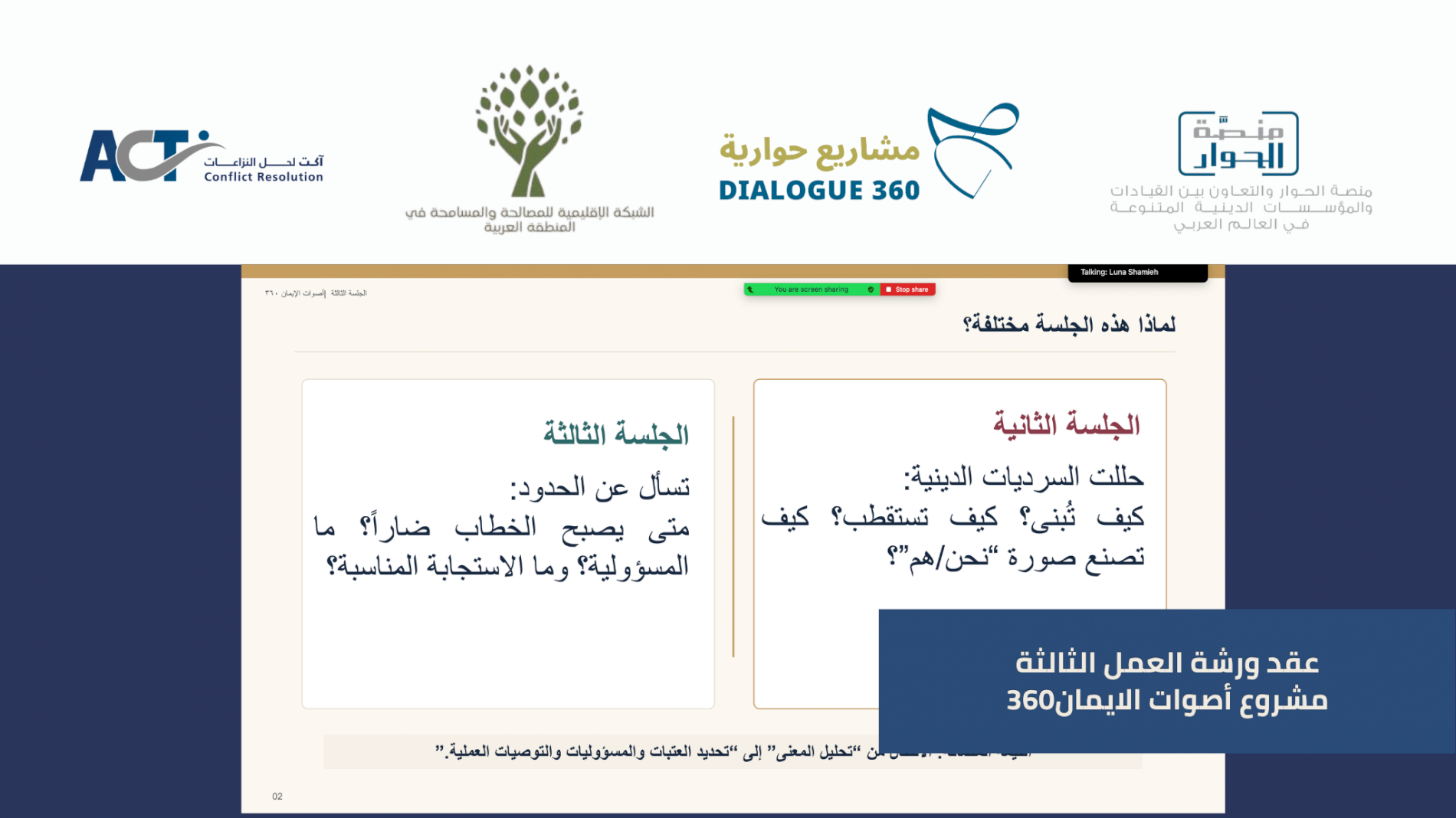
As part of the Faith Voices 360 project, the third workshop, titled "The Boundaries of Religious Discourse: When Does It Become Harmful?", was held by ACT for Conflict Resolution, in partnership with the Regional Network for Reconciliation and Forgiveness and the King Abdullah bin Abdulaziz International Centre for Interreligious and Intercultural Dialogue (KAICIID).
The workshop explored a central question:
"How can we protect freedom of religious expression without allowing religion to be used to justify exclusion or hatred?"
Participants examined examples from different contexts, discussing how religious discourse can, when detached from its ethical and humanitarian foundations, become a tool for division, mobilization, or the denial of others' dignity.
The discussion emphasized that combating religious hate speech does not mean opposing religion itself. Rather, it means protecting religion from misuse and restoring its role in promoting compassion, justice, and equal citizenship.
The workshop concluded by underscoring the importance of promoting an alternative religious discourse grounded in shared human values—one that rejects the exploitation of religion or historical narratives to legitimize exclusion or monopolize the representation of society or the state.
One of the key messages highlighted during the discussion was:
"Religion or historical narratives should never be used to legitimize exclusion or monopolize the representation of society or the state. Equal citizenship is the only legitimate foundation for rights and legitimacy."
Through these dialogue spaces, Faith Voices 360 continues to foster meaningful conversations, affirming that in times of crisis, religion can serve as a bridge to dignity and trust, rather than a tool for fear and division.